




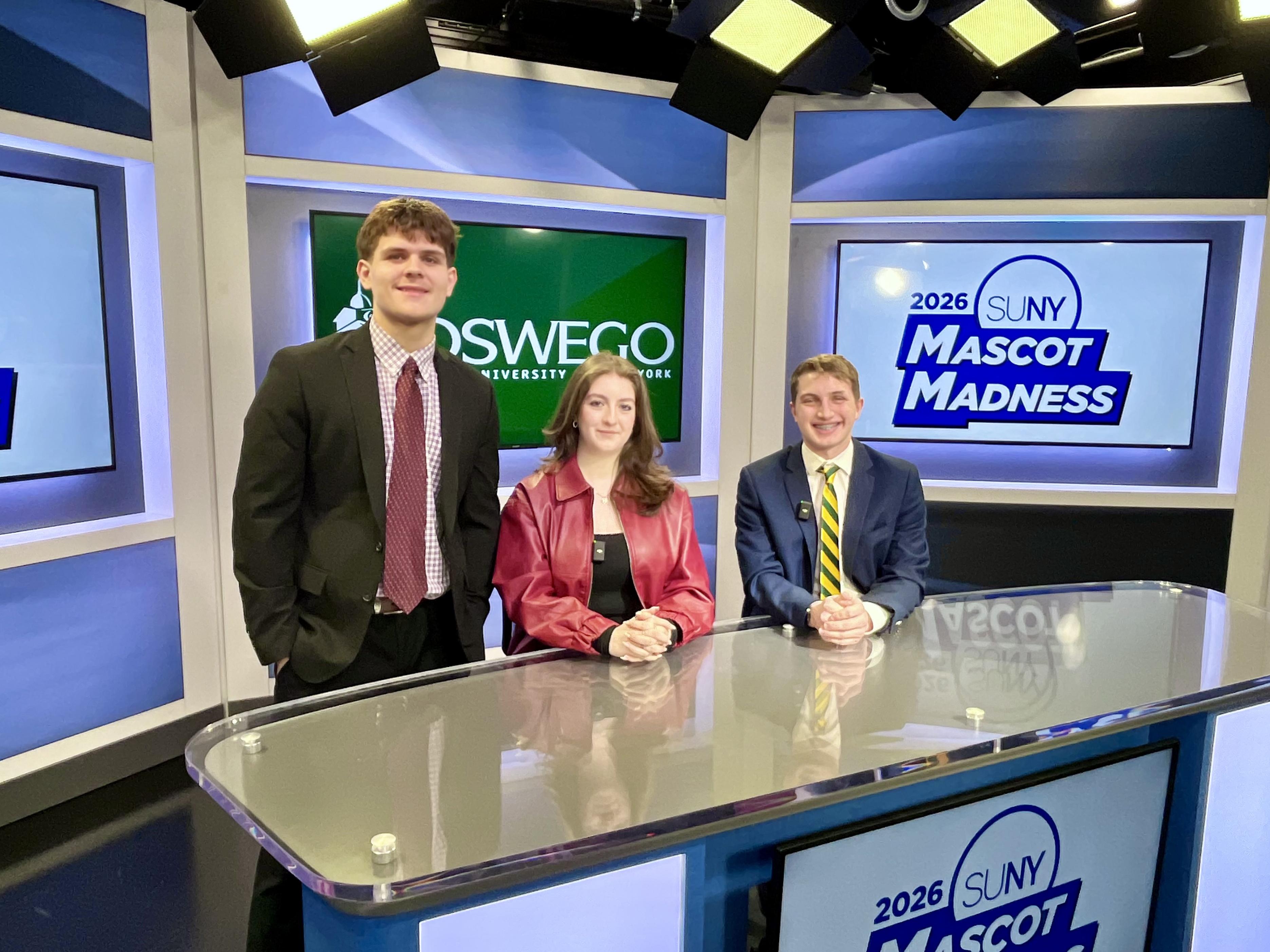
SUNY Oswego broadcasting and digital media students Luke Belanger, Michelle Smith and Joshua Matteson have earned attention and admiration across the state and beyond by providing ongoing “SportsCenter”-style coverage of SUNY’s annual Mascot Madness.
SUNY Oswego broadcasting and digital media students Luke Belanger, Joshua Matteson and Michelle Smith have earned attention and admiration across the state and beyond by providing ongoing “SportsCenter”-style coverage of SUNY’s annual Mascot Madness.
The popular competition between mascots at SUNY schools via social media, modeled on college sports tournaments including the basketball March Madness, has run since 2013, with the new feature of Oswego students providing video previews and recaps becoming a hit on SUNY’s social media channels while showcasing the broadcasting program and facilities.
The ball started rolling in January when Kyle Adams, SUNY’s associate vice chancellor for marketing and creative, reached out to Tim Nekritz, SUNY Oswego’s director of communications, knowing Oswego’s track record of success for producing outstanding broadcasting students.
Nekritz turned to Michael Riecke, chair and associate professor of communication studies, who took on the challenging job of selecting and recruiting three students from among a very talented program.
Not only are all three rising stars at Oswego -– and now beyond –- but their interest in broadcasting goes back to their childhoods. The experience allowed them to live out that dream and show people across SUNY schools and beyond that Oswego students can excel.
“I am incredibly grateful to SUNY for the opportunity to not only showcase our new state-of-the-art production facilities inside Hewitt Hall, but also to give a statewide audience a chance to see our incredibly talented broadcast and digital media students in action,” Riecke said.
Tyler King, the new professor of practice in communication studies, edited the six-episode series –- which included, for the final wrapup video, interviews with Chancellor John B. King Jr. and winning mascot Red from SUNY Oneonta (working around the fact that mascots don’t talk).
Chancellor King noted that more than 310,000 votes came in during the weeks of competition, and offered praise for Oswego’s students in the official release announcing Red’s victory.
“New Yorkers throughout the state cast ballots to support their SUNY campuses, and I also want to applaud the SUNY Oswego broadcast team of students for showcasing their sports journalism skills by keeping our Mascot Madness fans updated throughout the tournament,” Chancellor King said.
SUNY’s communication staff also offered praise for the professionalism, preparation and enthusiasm of the Oswego students, as well as the level of engagement for the social media posts.
Additional help in filming and production came from Shaun Secaur of communication studies and Emma Colling, assistant director of communications.
Winning teamwork
Even with a fluid and skilled team, the biggest challenge was a narrow production window. Sometimes the turnaround between one round and the next was one day, meaning students would find a time in their schedules to assemble, write and revise a script and shoot within an hour or so –- simulating the demands of real-time newsrooms and sports shows.
“The quick turnarounds have been fun,” Belanger said. “We've had to record with little time in between and that's always fun to perform under some pressure.”
They quickly settled into roles with Matteson and Smith working as anchors for most broadcasts giving recaps and previews, with Belanger’s Bracketology a breakout segment to dive deeper into matchups and trends.
All three students found working with each other and the supportive opportunity rewarding.
“First of all, it is awesome to have been recognized by two professors in my major as someone who is capable of representing our school on a big platform,” Smith said. “Besides that, it has been really great working with Luke and Josh as well as Tim and Professors Riecke and King to bring the tournament to life in a new way with a lot of creative freedom.”
“There's an in-between time where Michelle and I are done writing and we are just waiting on the cameras to be ready and Luke, Michelle and I chat and joke about pretty much anything,” said Matteson, who also admitted that they aimed to work in as many mascot puns as possible into the scripts. “This part makes everything so much fun and just helps me relax and enjoy covering mascots.”
Belanger agreed that the team atmosphere has been his favorite part.
“Josh and Michelle have been so fun to work with and are so very talented,” Belanger said. “Having Josh and Michelle as the anchors have made the videos look so good and it's made me look a little bit better than I actually am. The team of professors too have been so helpful and awesome to us. So cool to see an idea come alive and even cooler to see and be a part of how good this team has worked together.”
Professional preparation
Riecke said that the students’ preparation and ability to work in an atmosphere simulating the quick newsroom pace of professionals proved crucial to success.
“The best part of this project: Josh, Luke and Michelle did the heavy lifting,” Riecke said. “They handled the research and the writing. I always say we produce media professionals who are day-one ready after graduation, and our three hosts demonstrated that their work inside and outside of class is paying off. I’m proud of their efforts and the professionalism they brought to the process throughout the entire endeavor.”
“If there were a competition and a bracket for best broadcasters, I would take Luke, Josh and Michelle, and our students in general, over those at other more expensive and hyped schools any and every day,” Nekritz said.
Riecke also offered praise for Tyler King, whose skills and dedication made such a high-quality product possible.
“Professor King was instrumental in coaching the students and keeping the entire group on deadline,” Riecke said. “As the newest member of the Communication Studies Department, he’s wasted no time making his mark on our students and our broadcast and digital media and journalism programs.”
For Matteson, covering an unusual competition has been enjoyable and fed his creativity.
“I have always had that creative drive and Mascot Madness helped open the door,” Matteson said. “I learned that any project –- serious or ridiculous –- can take the same amount of focus and needs the right people to turn it from good to great.”
“Although it's been a bit tough sometimes, it's been incredibly rewarding moving fast and still putting out (in my opinion) pretty cool videos,” Belanger said. “I've learned a ton about myself and what some of my skills are. These style videos aren't something I've practiced too much but in the least cocky way, I think Belanger's Bracketology has been a major hit.“
Smith grew up inspired by women in sports broadcasting, and learning about WTOP’s first all-women’s hockey broadcast –- which she got to participate in this year –- convinced her to come to Oswego. Now she gets to pay it forward by representing the university and the broadcasting program in a winning way while helping show off the renovated Hewitt Hall to a larger audience.
“I have been learning a lot about collaborative work among people with different levels of experience and positions within the project,” Smith said. “I think that what I'm learning through Mascot Madness connects very well to material we cover in classes and taking this experience and what I have learned so far at SUNY Oswego with me into my future career is setting myself up for something great.”
Watch all SUNY Oswego episodes of Mascot Madness coverage:
- Preview
- Round 1 recap
- Round 2 recap
- Round 3 recap
- Round 4 recap
- Final recap
- Bonus: Behind the scenes covering Mascot Madness
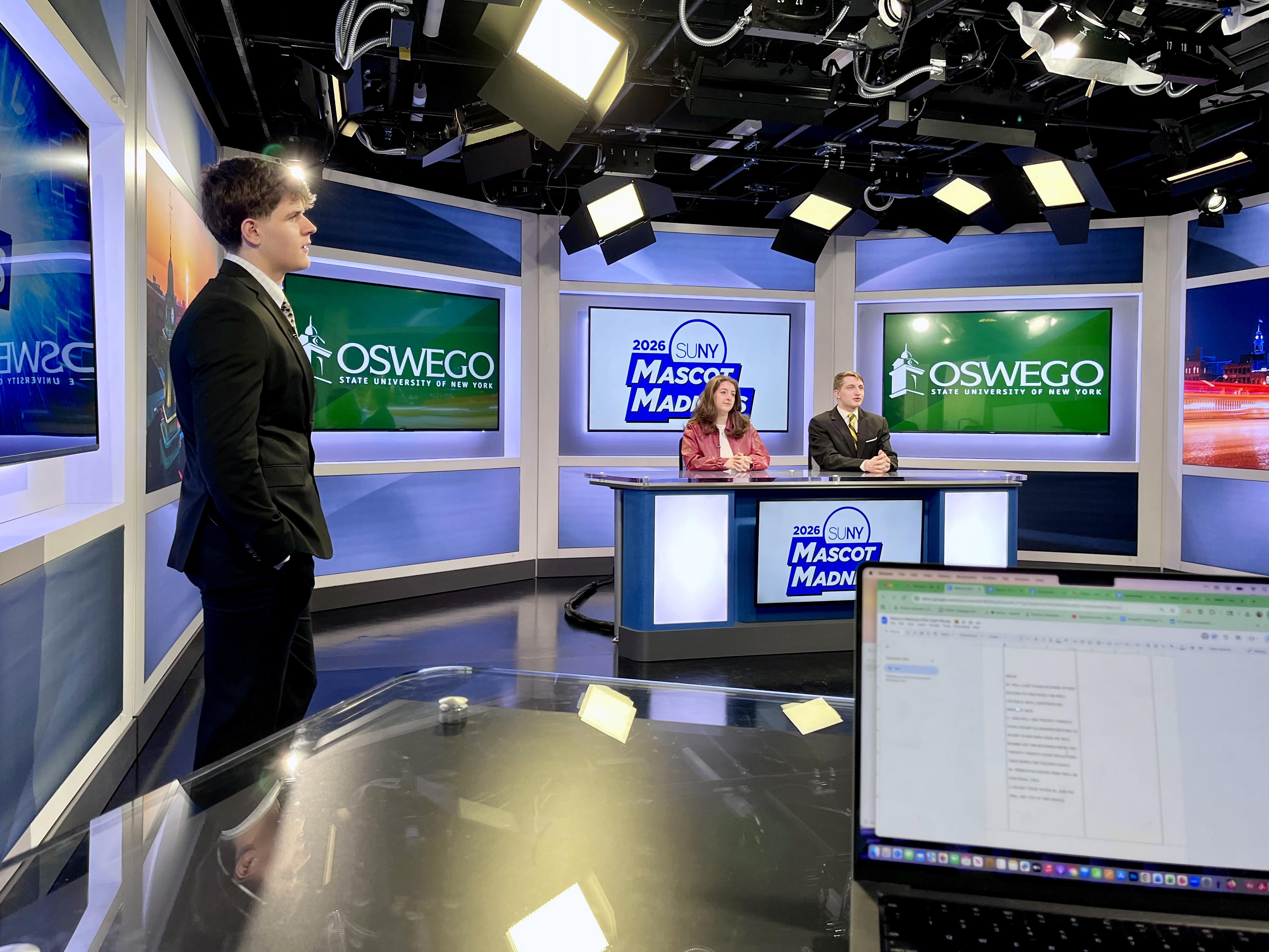
SUNY Oswego broadcasting students prepare to film an episode of their SUNY Mascot Madness recap show. From left are Luke Belanger, Michelle Smith and Joshua Matteson.