



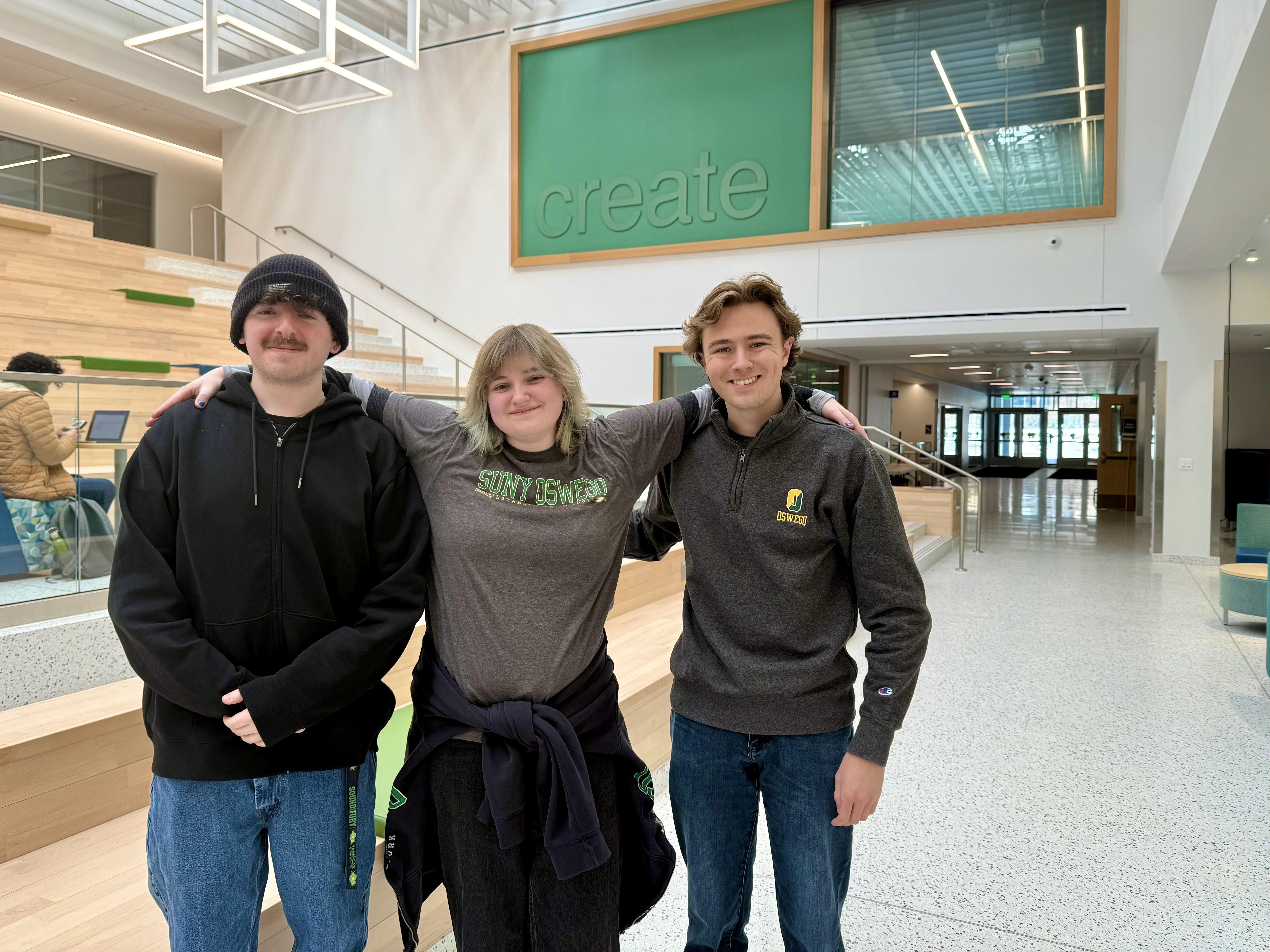
From left: Benjamin Goldblatt, Quinn Galuski and Michael Lavalette stand together in the newly renovated Hewitt Hall after earning national recognition at the 2026 BEA Festival of Media Arts.
Three SUNY Oswego students have earned national recognition for their media work from the Broadcasting Education Association (BEA).
Benjamin Goldblatt, Michael Lavalette and Quinn Galuski all earned honors in the 2026 BEA Festival of Media Arts — a national competition showcasing student work in broadcasting, film and digital storytelling.
All three are broadcast and digital media majors, with Galuski having a second major in cinema and screen studies.
This follows Oswego’s record-breaking success in the 2025 competition, with the university ranking among the top 50 public schools in the nation.
The awards earned in the 2026 competition are as follows:
- Michael Lavalette: First place in Instructional/Education Video for "State Social Media Bills and How They Affect a Minor's Freedom of Speech."
- Benjamin Goldblatt: Third place in Non-Narrative Audio for “2025 OCO Radiothon - Interview with Lucas Jassak."
- Quinn Galuski: Award of Excellence/Honorable Mention in Short Narrative Film for "Sweetest Ambrosia."
For department chair and associate professor Michael Riecke, who works closely with students through his classes, advising and WTOP student media, the recognition is about more than just the award itself.
“I see it as a talking point during job interviews,” Riecke said. “This gives them something explicitly to talk about — and not just talk about, but they can say other professionals saw their work and said it was one of the best.”
More importantly, he said, it reinforces something students may not always realize about Oswego and themselves.
“More than anything, it reminds our students that they are among the best,” Riecke said. “Sometimes at Oswego, we’re a humble bunch, and I love that about our culture. But I love it when our students get to celebrate the fact that they are really good and passionate about the work they’re producing.”
Students will also have the opportunity to network in Las Vegas at the annual BEA Awards ceremony, which runs concurrently with the National Association of Broadcasters (NAB) Show. Riecke stressed how incredible an opportunity this is for them.
“The NAB is the largest industry convention in the world,” he said. “People come from all over, and it takes up practically the entire Las Vegas Convention Center, a massive, massive facility. Our students will get to interact with professionals in the industry, and hopefully come back with new connections and ideas they can put to work on campus.”
From classroom work to award-winning projects
Each of the students’ projects started in the classroom — but took shape through their creativity, initiative and encouragement from faculty mentors.
Lavalette, who transferred to Oswego last year, was recognized for a video essay created in a media law course taught by assistant professor Jason Zenor.
“I took a media law class last semester, and one of the big projects was a legal research project,” Lavalette said. “I made a six-and-a-half-minute video essay, and after my professor graded it, he recommended that I submit it. I just decided, why not? I did not expect to win in the slightest.”
Now, he sees the project as something that will carry forward into his future career.
“I think this is a really strong portfolio piece because it’s something I fully researched, produced and created, and now it’s being recognized at this level,” Lavalette said.
Goldblatt earned recognition for an interview he produced during WNYO’s 24-hour Radiothon, an annual broadcast supporting Oswego County Opportunities.
“I’ve been involved with WNYO since my freshman year, and that’s how I learned about BEA,” Goldblatt said. “Every year I’ve been here, I’ve submitted something. This year, I had an interview that I really felt I did well on, so I submitted it just to see what would happen. It ended up winning, which was really surprising.”
He credits his experience with WNYO as a major factor in both his growth and success.
“The radio station has probably had the biggest impact on me. It’s made me into the person I am right now,” Goldblatt said. “I came in not really a social person and not willing to get out of my comfort zone. Doing radio helped me become more communicative and more comfortable putting myself out there.”
Galuski’s award-winning screenplay originated in a class taught by assistant professor Juliet Giglio and grew from an idea they had been developing over time.
“It’s an idea I’ve kind of had in my head for a long time,” Galuski said. “I wrote about a 10-page version of it before, but I felt like there was a lot more I could add, so I expanded it to about 50 pages and submitted what I had.”
“Professor Giglio was the one who encouraged me to submit it,” they added. “If it wasn’t for her and Professor Riecke, I probably wouldn’t have submitted my script.”
Learning by doing in Hewitt
Students say having access to the brand-new Hewitt Hall has allowed them to gain hands-on learning experiences and build community like never before.
“I really like the community aspect of Hewitt,” Goldblatt said. “Before, everything was spread out, but now I can walk in and see people in my major and people I have classes with. It’s a great place to meet people and collaborate.”
Galuski, whose classes are now largely based in Hewitt, said the space has helped shape both their creative and technical learning.
“In film production classes, getting to actually use a camera is really valuable,” they said. “I have a video game class where we’re actually playing games to understand the game mechanics. At WNYO, I’ve learned how to talk on air naturally and how to use the board — all of that practical experience.”
Riecke said that kind of environment reflects the realities of the media industry.
“The industry doesn’t live in silos the way it once did,” he said. “Film, television, journalism — all of these areas overlap. Being in the same space and working together helps prepare students for that.”
Faculty support makes the difference
For many students, submitting work to a national competition can feel intimidating — but faculty encouragement played a key role in pushing them to take the next step.
Riecke emphasized that recognition like this reflects a broader culture of support across Oswego departments, including faculty such as David Crider, who advises WNYO and regularly encourages students to submit their work.
“One of the beauties of our program is that our faculty, by and large, want to spend time in the trenches with the students doing the work,” he said. “And there is something about that student-mentor-teacher relationship that I think helps take us to the next level.”
He also noted that many students come in unsure of how they measure up to students from larger institutions — but quickly prove they also belong on the national stage.
“Sometimes students think they’re at a disadvantage,” Riecke said. “They might think, ‘I’m at a small institution in upstate New York — how can I compete with students at big-name schools?’ The fact of the matter is, they absolutely can compete, and they do.”
Not only do faculty encourage students to submit their work, but they also ensure that financial support is provided.
“There’s a fee to apply, and for a lot of students, they would get to that part and would be discouraged,” said Riecke. “It was a barrier. So a few years ago, we started a coordinated effort and identified a funding source to help students with those entry fees.”
Not only that, but the department has also collaborated with the alumni association to help students get to the conference in Las Vegas.
“Thanks to our generous alumni, we're using some of our foundation funds to help get the students to the conference in Las Vegas to receive their awards,” Riecke said. “And I can't overstate what a big deal it is. It's an extraordinarily competitive competition, and to see Michael place first in the instructional video category, you know, it just speaks to the quality of work that our students are doing.”
One of Riecke’s favorite things about Oswego, he said, is watching students evolve from humble beginnings — and their BEA success is just one example of that.
“It’s a reminder that we have a strong program with a tremendous legacy and that we’re still going strong,” he said. “We’re a place where students can come in, build confidence and realize that they can do this — and be successful.”